


Best Home Theater Seating for Small Rooms
Table of Contents
- Home Theater Seating Dimensions: What to Measure Before You Buy
- Small Room Theater Layout: Seat Capacity, Walkways, and Delivery Access
- Space-Saving Theater Recliners and Wall-Hugger Recliners Compared
- Frequently Asked Questions
Last Updated: October 9, 2026
Home Theater Seating Dimensions: What to Measure Before You Buy
Finding the best home theater seating for small rooms starts with a tape measure.
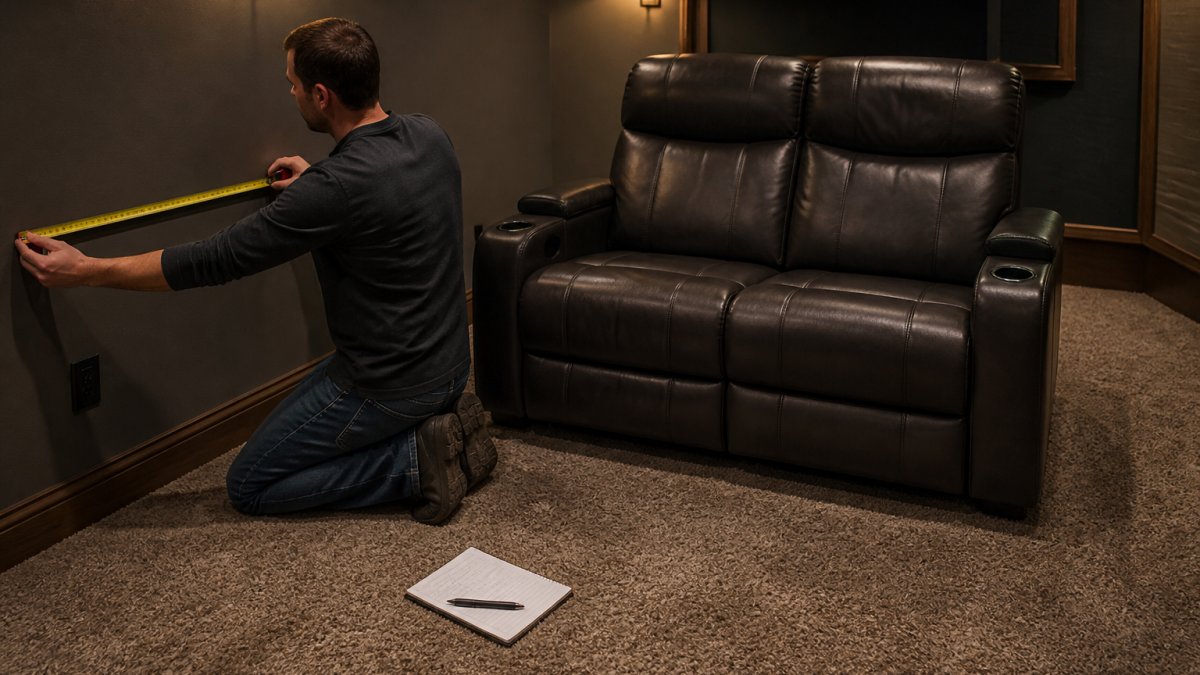
Before ordering, measure your available wall width and compare it with the seating’s total width, upright depth, fully reclined depth, and required rear clearance. Leave enough space for walkways and doors to open.
Also measure the delivery route, including doorways, hallways, and tight turns. Check the manufacturer’s delivery dimensions and whether removable backs affect access.
A common mistake is checking width alone. Reclining seats need additional space as the footrest extends and the backrest moves.
For a compact seating option, consider the Samery wall-hugger reclining loveseat. Before ordering, confirm its total width, fully reclined depth, and required rear clearance against the manufacturer’s specifications.
How do you measure a small room for theater seating?
Measure the available width and depth of the seating area. Add the manufacturer’s required rear clearance to the seat’s fully reclined depth, then check that enough room remains for walkways and doors to open. Include any consoles or tables in your layout.
If space is tight, compare actual dimensions across wall-hugger, standard reclining, and non-reclining options. A wall-hugger label alone doesn’t guarantee a smaller overall footprint.
What is the difference between upright and reclined depth?
Upright depth measures the seat from front to back with the footrest closed and the backrest upright. Fully reclined depth measures its footprint when extended. Check whether the manufacturer lists rear wall clearance separately; if either measurement is missing, confirm it before buying.
Small Room Theater Layout: Seat Capacity, Walkways, and Delivery Access
The right seating capacity depends on your room and the dimensions of the seating you choose. Prioritize clear walkways, doors that open freely, and comfortable views of the screen.
Start by marking the screen location and available seating area. Tape out each seat’s fully reclined footprint, including required rear clearance. Add consoles and tables, then check that people can enter, leave, and move around the room. For power recliners, confirm outlet placement and keep cords out of walkways.
Wide armrests and center consoles can take up valuable room. Compare the total width of each complete seating configuration rather than judging capacity by seat count alone.
How many seats fit on a narrow wall?
Compare the usable wall width with the total width of the proposed seating, including armrests, consoles, and any required gaps. Then check reclined depth, rear clearance, and walkways. For individual chairs, use each chair’s overall width; for a connected row, use the manufacturer’s total row width.
What is a staggered layout?
A staggered layout places seats at different distances from the screen rather than in one straight row. It may suit some rooms, but seats farther back can have their view blocked by people in front. Check sightlines from seated eye level and measure each seat’s reclining clearance before choosing this arrangement.
Space-Saving Theater Recliners and Wall-Hugger Recliners Compared
Wall-hugger recliners generally move forward as they recline, reducing the space needed behind them. They still require manufacturer-specified rear clearance and room for the extended footrest.
Option |
Space Considerations |
When to consider it |
Tradeoff |
|---|---|---|---|
Wall-hugger recliner |
Reduced rear clearance; check fully reclined depth |
Seating close to a wall |
May still extend substantially into the room |
Standard recliner |
Check rear clearance and fully reclined depth |
Layouts with sufficient reclining space |
Can require more clearance behind the seat |
Manual recline |
Reclining footprint depends on the model; no outlet needed for the mechanism |
Rooms without a convenient outlet |
Check access to the handle and how the mechanism operates |
Power recline |
Reclining footprint depends on the model; requires power access |
Shoppers who prefer powered adjustment |
Plan outlet access and keep cords clear of walkways |
Armless or modular seat |
May reduce total row width; check the assembled configuration |
Flexible layouts or narrow seating areas |
Arm support, cup holders, and other features vary |
For a wall-hugger option, the Samery reclining loveseat offers two independently operated manual reclining seats, a storage console, and cup holders. Lounge Apex lists its overall width at approximately 65.5 inches and required rear clearance at approximately 6 inches. Confirm its fully reclined depth before ordering to ensure it leaves enough room for walkways.
For powered adjustment, the CANMOV power reclining theater loveseat includes independently controlled seats, USB charging ports, and a center console. Its listed overall dimensions are approximately 75 inches wide by 35 inches deep, but that depth should not be treated as its fully reclined footprint. Confirm reclining clearance and plan access to an electrical outlet.
If you’re considering three seats, the ANJ power home theater recliner set of three includes individual chairs approximately 40 inches wide each. A straight row would span about 120 inches before gaps or walkway allowances, making it a better option for rooms with sufficient width. Confirm fully reclined depth, rear clearance, and outlet access before choosing the set.
Frequently Asked Questions
How much space do you need behind a recliner?
The required clearance depends on the specific recliner and its mechanism. Wall-hugger designs still need the clearance specified by the manufacturer. Check that measurement before ordering, and allow for the seat’s fully reclined depth as well as space to walk around it.
Are wall-hugger recliners suitable for small rooms?
They can be a good option when space behind the seat is limited. However, reduced rear clearance doesn’t necessarily mean a smaller overall footprint. Compare the chair’s width, fully reclined depth, and manufacturer-specified wall clearance with your available space.
Is a loveseat or two individual recliners better for a small home theater?
A loveseat may save width by sharing outer armrests, but a center console can increase its footprint. Two individual recliners offer more placement flexibility, though their combined width may be greater. Compare the actual dimensions, reclining space, and delivery-access requirements of both options rather than assuming one will fit better.


